 Voice-first AI journal in private beta
Lumyr
Lumyr turns a few honest minutes a day into gentle insight through guided prompts, mood tracking, and an AI that helps people notice patterns they would otherwise miss.
- 625
- beta users
- 120
- daily journalers
- 1.2K
- records written
- React Native and Expo
- FastAPI and Pydantic AI
- Supabase and pgvector
- Deepgram and OneSignal

Write it out. Let AI reflect it back.
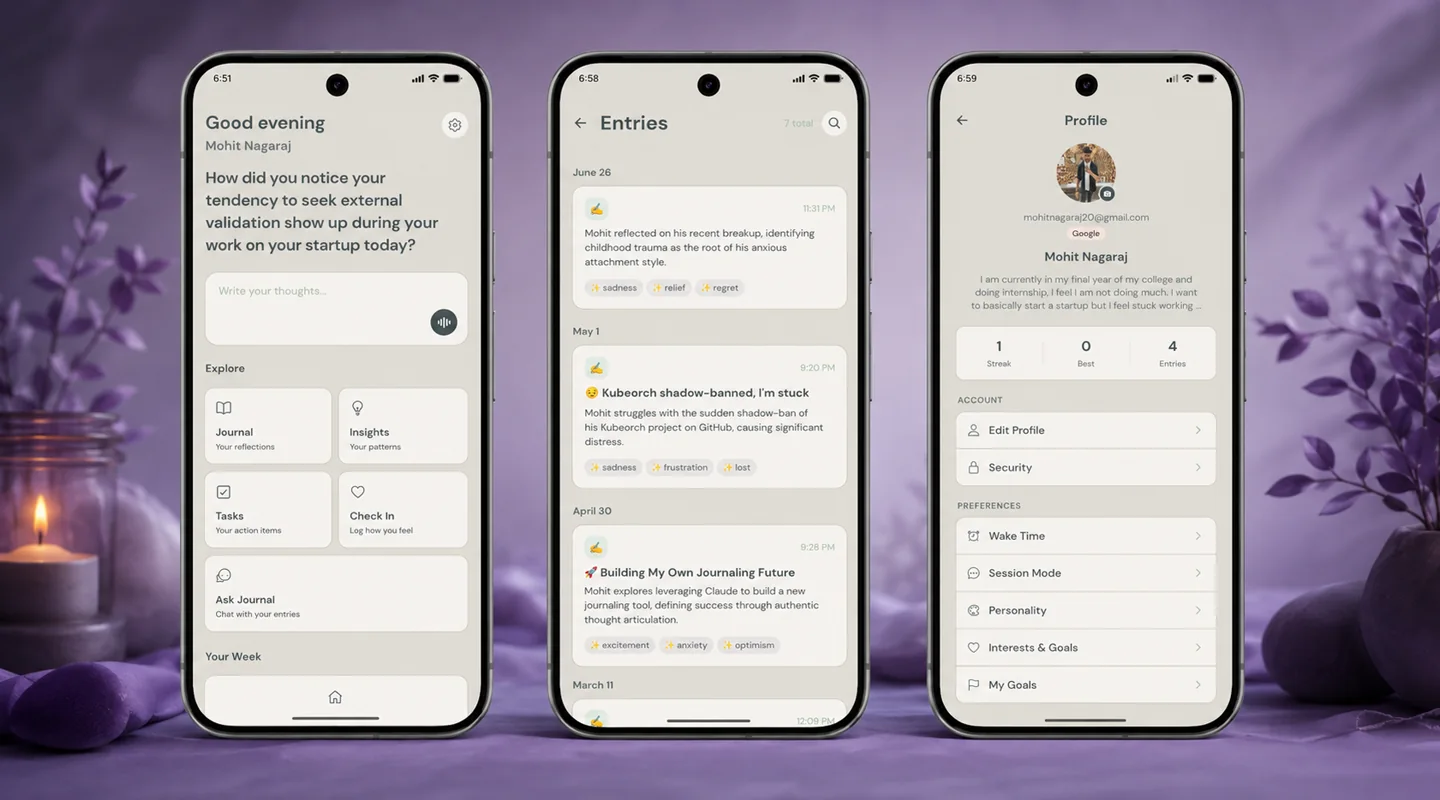
Lumyr is currently in progress as a private beta. It turns a few honest minutes a day into gentle insight through guided prompts, mood tracking, and an AI that helps people notice the patterns they would otherwise miss.
I started Lumyr around a different loop: it asks one relevant question, lets you answer by voice or text, and quietly converts the session into tasks, memories, emotions, follow-ups, and a clearer model of who you are becoming.
The product spans an Expo mobile app and a FastAPI intelligence layer. Every entry can influence short-term nudges, long-term episodic memory, six evolving identity documents, journal chat, weekly synthesis, and the next question Lumyr asks.
A journal that remembers, synthesizes, and follows up.
Lumyr removes the blank-page problem while making every reflection compound into useful personal context rather than disappear into a chronological feed.
- 01
Voice-First Journal Sessions
Stream speech through Deepgram transcription, generate memory-aware follow-up questions, and preserve drafts when a live session is interrupted.
- 02
Three-Tier Personal Memory
Separate expiring nudges, emotionally weighted episodic memories, and a permanent core model that evolves instead of growing without structure.
- 03
Typed Agent Pipeline
Use Pydantic AI agents to extract tasks, people, emotions, goals, summaries, and next steps into validated application data.
- 04
Journal Search and Chat
Combine semantic and keyword retrieval so people can find past entries or have a grounded conversation with their own journal history.
- 05
Weekly Insight Synthesis
Turn writing volume, emotional trends, recurring people, wins, struggles, and themes into a structured weekly reflection.
- 06
Proactive Daily Support
Deliver wake-time morning briefs, contextual nudges, streak celebrations, weekly goals, and native iOS and Android widgets.
A typed agent system built around durable personal memory.
The Expo 55 application uses React Native, Expo Router, TanStack Query, Supabase Auth, audio streaming, haptics, push notifications, and native widget integrations across iOS and Android.
The FastAPI backend centralizes Gemini-backed Pydantic AI agents for extraction, follow-ups, onboarding, question generation, synthesis, weekly insights, and journal chat. Supabase Postgres, pgvector, row-level security, Deepgram, LiteLLM embeddings, OneSignal, and recoverable background jobs provide the durable system around those agents.
Founder, product engineer, and AI systems builder across mobile and backend.
I shaped the product loop, designed the three-tier memory model, built the React Native experience, implemented the FastAPI routes and typed agents, and connected voice, embeddings, notifications, analytics, weekly synthesis, goals, and widgets.
The hardest product decision is deciding what the system should remember. Lumyr distinguishes temporary context from meaningful events and slowly evolving identity, so one bad day cannot rewrite the user model while repeated patterns still become visible over time.
A journal becomes valuable when it remembers enough to notice change, but stays structured enough to know what should fade.